

BlogPublished Jul 12, 2024
8 Reasons Your Organization Needs E-Signature Now
There’s no better time to start using e-signature to reduce costs, accelerate sales, improve productivity and create better experiences for customers.

An electronic signature (or e-signature) is a legally binding way to sign documents online from any device.
Learn how to set up and send agreements for signature and see how your recipients can easily esign them.

Discover how your team can save time and money using the leading electronic signature application.
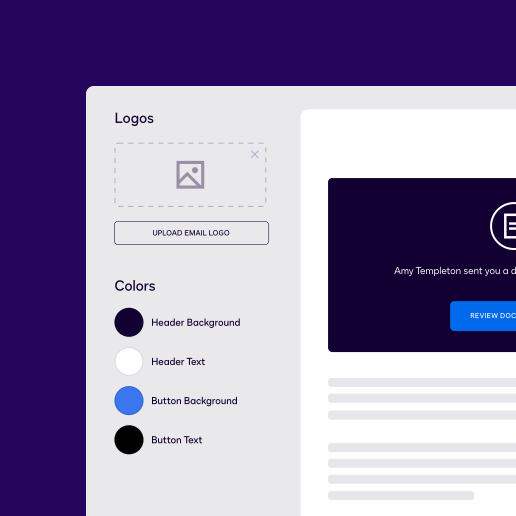
Consumers, partners, employees, and vendors expect convenient, fast agreement experiences. Enable them to esign practically any type of agreement on almost any device.
Elevate your customer signing experience with confidence and clarity. Our AI-Assisted Summary and Q&A features increase trust in agreements, while custom branding and responsive signing ensure an intuitive process.
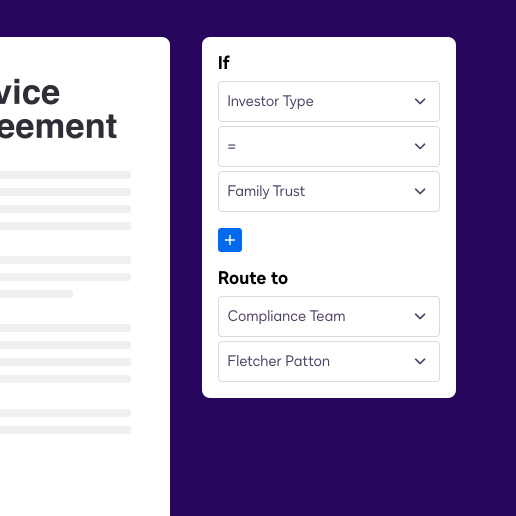
Empower your teams to quickly prepare, route, and approve agreements so they can focus on the big picture.
Our AI-assisted tools, powered by Docusign Iris, take the manual work out of agreement preparation, and shared templates and collaborative commenting streamline teamwork. And take advantage of configurable workflows to tackle your trickiest agreement challenges.
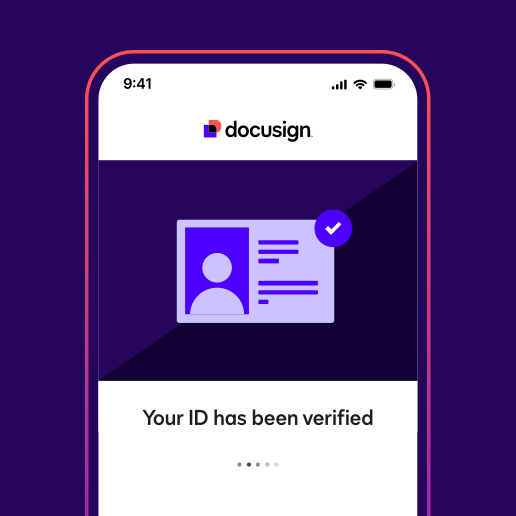
Protect your agreements with enterprise-grade security and compliance controls without sacrificing the user experience. Get an added layer of security with enhanced signer identification, pre-send data verification, and robust threat and fraud detection. Plus get support for your compliance with digital signature laws.

Easily integrate your agreements with your apps of choice, including Salesforce, Microsoft, Google, Zoom and more. Connect and extend your signature workflows with an industry-leading number of pre-built integrations and award-winning APIs.

Docusign regularly releases new innovations to help your organization enable better ways of working. Here are a few notable innovations.
Get agreements signed faster with notifications delivered to signers’ mobile devices.
Learn MoreAdd more flexibility, control and ease to your eSignature workflows.
Learn MoreStreamline data collection and speed up signing.
Learn MoreSimplify multi-step transactions by bringing people and agreements together in one secure, collaborative hub.
Learn MoreMore than 1.7 million customers and 1 billion people use Docusign.
Explore More Stories



Securely create, send, and sign agreements by starting a eSignature plan today.
There’s no better time to start using e-signature to reduce costs, accelerate sales, improve productivity and create better experiences for customers.
Docusign eSignature offers five key benefits for businesses looking to automate their agreements—including a superior signer experience, comprehensive security, and smarter workflows.

Time to bill your client? Our professional invoice template is customizable so it's easy to edit, detail charges and change payment terms.

There’s no better time to start using e-signature to reduce costs, accelerate sales, improve productivity and create better experiences for customers.
Docusign eSignature offers five key benefits for businesses looking to automate their agreements—including a superior signer experience, comprehensive security, and smarter workflows.
Learn e-signature definitions, what you can esign, and more.
An electronic signature is a catch-all term for any electronic process that indicates acceptance of an agreement or a record. The U.S. Federal ESIGN Act defines an "electronic signature" as “an electronic sound, symbol, or process, attached to or logically associated with a contract or other record and executed or adopted by a person with the intent to sign the record.”
The laws surrounding e-signatures enhance the credibility and trust of electronic records.
Electronic signatures have been used for electronically signing offer letters, sales contracts, permission slips, rental/lease agreements, liability waivers, financial documents, etc. They are legally enforceable in most business and personal transactions worldwide. Learn more in our eSignature Legality Guide.
A digital signature is a type of electronic signature generated via a digital certificate. Digital signatures provide additional security for online documents. A digital signature helps securely associate a signer with a specific document. Digital signatures form a digital “fingerprint” and can be used to validate signer identity and demonstrate that the signed document has not been tampered with.
The terms “electronic signature” and “digital signature” are often conflated. For the vast majority of agreements and records, an electronic signature is sufficient. A digital signature is a subset of electronic signature that adds another layer of security to a signed document. A digital signature is supported with a digital certificate and uses Public Key Infrastructure (PKI), which adds proof of signer identity and enhanced security to a legally enforceable signature.
Yes, e-signatures are legally recognized around the world. In the U.S., the ESIGN Act, which was signed into law in 2000, grants legal recognition to electronic signatures and records if all parties to a contract choose to use electronic documents and to sign them electronically. Many foreign jurisdictions also recognize the legal effect and admissibility of electronic records. An electronic signature, like those supported by Docusign eSignature, is typically all that is needed to create a legally enforceable document. There are laws that demand certain requirements for e-signatures to be deemed legally enforceable. Using secure electronic signature software like eSignature can help you meet these security and compliance standards
The majority of commonplace agreements and forms can be signed electronically. Examples of documents that may be signed electronically include NDAs, purchase orders, vendor agreements, insurance claims and hiring contracts.
With Docusign eSignature, signing is always free. Recipients click a link to open the agreement on a device of their choice, such a mobile phone, tablet or computer. Tabs and simple instructions guide the user through the signing process, even adopting an electronic signature. The recipient clicks Finish to save the signed document.
With Docusign eSignature, you can upload documents in formats such as Microsoft Word, PDF or other common formats. You can upload documents from your computer or popular file-sharing sites like Box, Dropbox, Google Drive and OneDrive.
Start esigning today.
